When Haiku Becomes Image — Poetry Beyond the Page
Fern Jean-Joseph’s creative practice begins with haiku, but rarely ends on the page. Drawing on a long-standing affinity with Japanese aesthetics, she explores how poetry can move into matter, image, movement and sound, allowing a poetic sensation to be experienced rather than simply read.
Her collection La Vie en 3 Lignes / Life in 3 Lines forms the foundation of this evolving approach. From its short, concentrated poems emerged a desire to explore what might happen when the economy of haiku, its silence, suggestion and space, is translated into another medium.
Poetry in torn paper
Chigiri-e, the Japanese art of creating images from torn paper, offered a natural extension of this enquiry.
Rather than illustrating a haiku literally, Fern uses fragments of paper, layering, texture and abstraction to recreate its emotional atmosphere. A torn fragment can behave almost like a syllable: fragile and incomplete on its own, but capable of becoming part of a larger visual language.
In Silence: Fifty Shades, hundreds of individually torn pieces of Japanese paper accumulate through subtle variations of white, blush, grey and deepening blue.
Silence is treated not as absence, but as a presence with its own weight and texture. As the composition moves from luminosity towards density, its character changes, from stillness and contemplation to something heavier, almost palpable.
A Deafening Silence
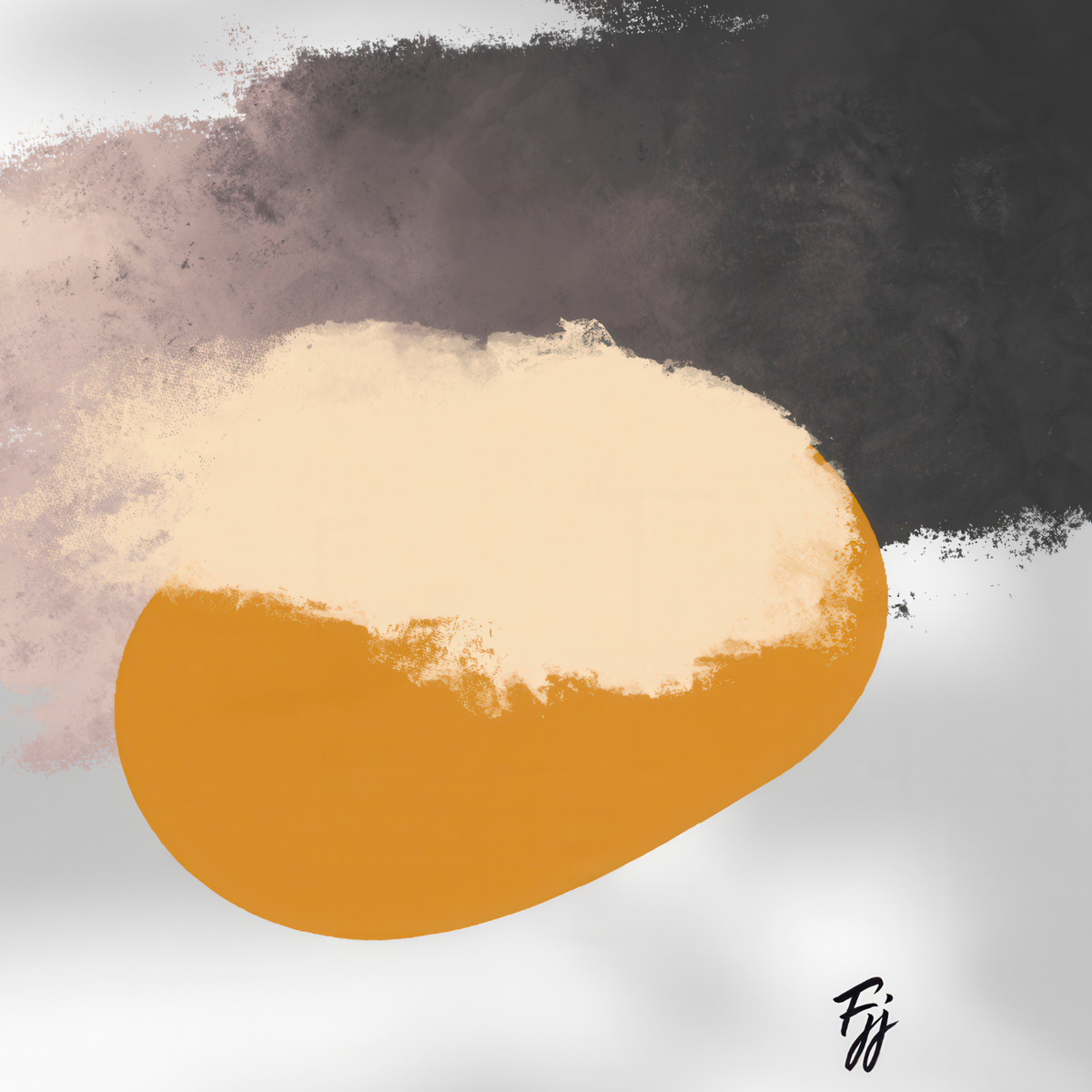
The same enquiry continues digitally in A Deafening Silence.
Here, colour and form replace torn paper while retaining the restraint and suggestiveness of haiku. A luminous golden presence emerges beneath layers of pale pink, muted grey and deep charcoal, creating a tension between light and darkness, revelation and erasure.
The work does not attempt to explain an emotion. Like a haiku, it reduces rather than elaborates, creating a space in which something intangible can be felt.
This is central to Fern Jean-Joseph’s wider practice: poetry does not have to remain confined to words. It can inhabit paper, image, film or an immersive environment while retaining the silence and openness that give haiku its particular resonance.
From image to movement
Since 2017, this exploration has progressively expanded into moving image. What began as haiku accompanied by still photography evolved into short poetic films in which text, movement and music form a single composition.
That progression eventually led to Under the Same Sky, an extended poetic film created from haiku in Life in 3 Lines written in response to the war in Ukraine.
The medium changes, but the underlying question remains the same:
What happens when poetry is no longer only something we read, but something we can see, hear and inhabit?